
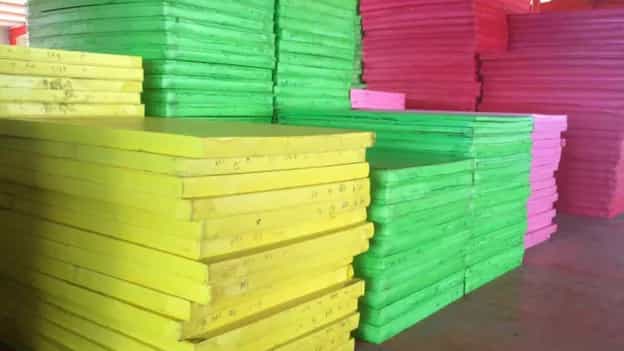
How to produce sheet foam
Foam production is a completely industrial process and full of details, which requires raw materials, special formulations and unique machinery. Sometimes foams are produced by gas injection method, sometimes by baking method and sometimes by cold foam method, and the percentage of raw materials will be different depending on the type of foam produced. A viscous material comes out of the mixer as the output of the first stage. In the next stage, this viscous material is placed in the extruder to form flat sheets by passing through the metal rollers. The speed of these rollers is pre-adjusted to apply the necessary pressure to produce dense foam sheets. In the last step, the flat foam sheets enter the vulcanization machine for molding. The temperature and pressure applied in this step determine the density, flexibility and quality of the foam, and a foam that fits the dimensions of the mold is obtained.
How to produce foam roll
The primary material of foam roll is EVA foam sheet layers with desired thickness. According to the desired length of the foam roll, several sheets of foam are glued together by a welding machine or apparatus to form a cup roll. In the next step, this roll cup is placed behind the cutting machine. In the first and second stages of cutting, soapy and JB rolls with different thicknesses are produced, collected and set aside. Now it is the turn of the main cutting and production of foam roll.
Once again, the thickness of the foam is adjusted on the machine and cutting begins. Two rotating rollers collect the cut foam sheets in front of the cutting machine, and after the cutting round is finished, the cup roll will be packed. These steps continue until the thickness of the remaining foam in the machine is less than the thickness of the foam roll. In this case, the remaining foam on the cup roll is cut and collected as the soapy foam of the last layer.

Raw materials needed to produce foam
The raw material of EVA sheet and roll foams is a combination of ethylene and vinyl acetate. For the production of these products, vinyl acetate plastic particles with a weight percentage of 10 to 40% and of course polyethylene materials are used. Also, in the molding process, by changing the amount of foaming and catalyst additives, they change the degree of hardness, density and flexibility of the foam.
Other materials required for foam production are:
Talc powder;
Calcium carbonate filler;
Stearic acid lubricating agent;
DCP cross-linking agent;
AC foaming agent; zinc;
colored masterbatch to produce foam in different colors;
fireproof additives to increase thermal insulation of foam;
anti-static agent to produce anti-static foam
